4.1
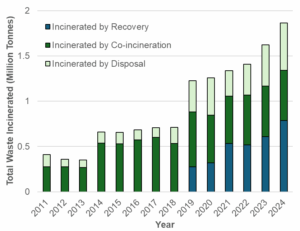
Whilst the increase in the quantity of waste incinerated and growth in available capacity reflect progress in moving away from landfill, they also signal a growing reliance on incineration. This trend, combined with projected overcapacity from 2027 onwards, could lead to several negative outcomes.
4.2
Firstly, excess capacity can result in ‘lock-in’ effects where long-term investment in incineration infrastructure and waste management contracts can undermine preferable waste management options, such as waste prevention, reuse, and recycling. Secondly, burning residual waste releases emissions and contributes to adverse climate impacts. Although incineration is currently less climate damaging than landfill, unchecked growth, changes to waste composition, and wider decarbonisation will make incineration less favourable over time, which if unaddressed will have implications for Scotland’s climate ambitions. Thirdly, incineration poses risks to human health and the environment through the release of pollutants that can reduce air quality and contaminate soil and water.
4.3
Accordingly, to prevent (or mitigate) the potential for harm to be caused from incineration lock-in, incineration must be carefully managed and controlled. This requires an effective regulatory framework, robust and transparent oversight, and accurate long-term planning.
Residual waste management cap
4.4
The indicative cap recommended by the Review was intended to act as a strategic benchmark for decision making, ensuring compliance with the objectives of the waste hierarchy, and preventing overcapacity that could undermine future recycling and waste reduction efforts. The Scottish Government accepted this recommendation in June 2022[5] and committed to developing a cap. However, the cap has not yet been implemented.
4.5
During ESS’ enquiries, the Scottish Government advised that the failure to develop the cap was due to the need for further and more robust data. The Scottish Government also explained that work to improve the quality of waste data was underway, including digital waste tracking and engagement with key partners.
4.6
The purpose of an indicative cap is to provide a level of certainty on required capacity and the pace at which it should decline, helping to prevent unchecked growth of incineration capacity. ESS considers the absence of such a cap is a significant weakness, as it limits the effectiveness of existing controls in avoiding overcapacity and the associated environmental risks. Introducing a cap would establish a clear benchmark, strengthen decision-making, enhance accountability and transparency, and reduce the risk of long-term overcapacity lock-in and its negative impacts.
4.7
ESS accordingly approached the Scottish Government, setting out the potential ineffectiveness of existing controls and the importance of developing a cap to ensure that current and future incineration capacity decisions adequately reflect Scotland’s residual waste management needs. ESS recommended that the Scottish Government should develop an indicative cap as a priority. The Scottish Government accepted this and agreed to develop an indicative residual waste treatment cap through Scotland’s Residual Waste Plan, which is scheduled for completion in 2027. Additionally, the Scottish Government committed to publishing an updated capacity analysis to ensure the latest forecasts are publicly available and to continue to monitor infrastructure developments in collaboration with the Scottish Environment Protection Agency (SEPA), Zero Waste Scotland (ZWS) and local authorities.
Governance of new incineration facilities
4.8
National Planning Framework 4 (NPF4)[6] guides decision making by planning authorities and restricts the development of new incineration capacity. NPF4 Policy 12(g) states that proposals for new incineration facilities will not be supported except in very limited or exceptional circumstances. In addition, a Direction[7], issued by Scottish Ministers under the Town and Country Planning (Development Management Procedure) (Scotland) Regulations 2013[8] (‘the 2013 Regulations’) is currently in place, requiring all planning authorities to notify Scottish Ministers of any new incinerator applications and whether they intend to approve them. This Direction helps ensure NPF4’s principle of restricting new capacity is being upheld. The Scottish Government has confirmed to ESS that, since the Review, no further planning permissions for new incineration facilities have been granted.
4.9
In ESS’ view, these controls are broadly effective in preventing the development of new incineration facilities in Scotland, as proposals are generally not supported[9], and Scottish Ministers have oversight of all planning applications. This provides assurance that any new capacity is subject to scrutiny and that appropriate planning conditions can be applied where necessary. The introduction of a residual waste management cap will supplement these controls in helping prevent overcapacity lock-in and its associated environmental and human health risks.
Governance of in-pipeline and existing facilities
4.10
There are several in-pipeline and operational facilities currently in Scotland. The Scottish Government considers incineration capacity at these sites to be controlled through two mechanisms: the planning system and SEPA’s permitting regime.
4.11
In terms of the first mechanism, the Scottish Government explained to ESS that, under the planning system:
- physical extensions undertaken to allow increases in incineration capacity require fresh planning permission
- operators may also need to apply under Section 42 of The Town and Country Planning (Scotland) Act 1997[10] to vary conditions in the original consent, such as capacity limits, where those conditions exist
- planning authorities are encouraged to consider the intent of NPF4 policy 12(g) when assessing individual cases
- Scottish Ministers also have general powers under the 2013 Regulations to require notification of planning applications and may call them in[11]
4.12
Despite these controls, ESS understands that capacity has the potential to increase at existing incinerator facilities without any structural changes, meaning no new planning permission is required. Furthermore, Section 42 applications may not be required if the original consent lacks conditions controlling capacity. The Dunbar Energy Recovery Facility illustrates these loopholes in the regulatory system: in 2023 permitted capacity at this facility increased from 325,000 to 390,000 tonnes per annum[12] without any structural changes and therefore new planning consent was not required. Additionally, the original planning consent did not have any conditions controlling capacity which meant a Section 42 application was also not required.
4.13
The second mechanism cited by the Scottish Government is delivered through SEPA’s regulation under the Environmental Authorisation (Scotland) Regulations 2018 (as amended)[13] (EASR)[14]. Schedule 22, Part 2, Paragraph 5(1)(b) of EASR requires SEPA to ensure that authorisations regulating incineration and co-incineration activities include the facilities total waste incineration capacity. However, during ESS’ enquiries, SEPA confirmed that it does not consider national capacity when determining or varying authorisations for individual facilities. In ESS’ view, the absence of national capacity as a material consideration when limiting capacity at individual facilities creates the potential for incineration capacity to increase without assessing if this aligns with Scotland’s overall residual waste management needs.
4.14
For the above reasons, ESS does not consider that the safeguards described by the Scottish Government comprehensively control capacity at pipeline or existing incineration facilities. Accordingly, ESS approached the Scottish Government to highlight these gaps within the existing planning and regulatory frameworks and set out the need for strengthening to ensure that there is full and proper consideration of national capacity when determining individual decisions to prevent overcapacity lock-in. ESS did not prescribe how this should be achieved but emphasised that, without intervention, incineration capacity could increase unchecked and without adequate oversight. The Scottish Government accepted ESS’ recommendation and agreed to ensure the residual waste management cap is reflected in SEPA’s permitting regulations, meaning that national capacity is considered when assessing all environmental authorisations.
[5] Scottish Government Response to: Stop, Sort, Burn, Bury? The Independent Review of the Role of Incineration in the Waste Hierarchy in Scotland
[6] National Planning Framework 4 is the national spatial strategy for Scotland, setting out principles and priorities for national development and planning policy.
[7] Chief Planner letter and Notification Direction – Energy from Waste (Incineration and Advanced Thermal Treatment) Facilities: 17 November 2021 – gov.scot
[8] The Town and Country Planning (Development Management Procedure) (Scotland) Regulations 2013
[9] The Scottish Government confirmed to ESS that proposals will not be supported, except under limited circumstances where a local or national need has been sufficiently demonstrated (e.g. where no local facility exists, to avoid transporting waste elsewhere).
[10]Operators can apply to vary conditions attached to previously granted planning permissions. This includes changes to capacity restrictions imposed or adjustments for structural or operational modifications. These variation applications are determined by the relevant planning authority and partially manage any changes to incineration capacity.
[11] Under section 46(1) of the Town and Country Planning (Scotland) Act 1997, ministers may give a direction requiring a planning application to be referred to them instead of being dealt with by the planning authority.
[12] dunbar-energy-recovery-facility-draft-decision-document-.pdf
[13] The Environmental Authorisations (Scotland) Regulations 2018 (as amended)
[14] These regulations replaced the Pollution, Prevention and Control (Scotland) Regulations 2012 on 1 November 2025, which previously delivered an equivalent function.