• 03 November 2026

1. What is this call about?

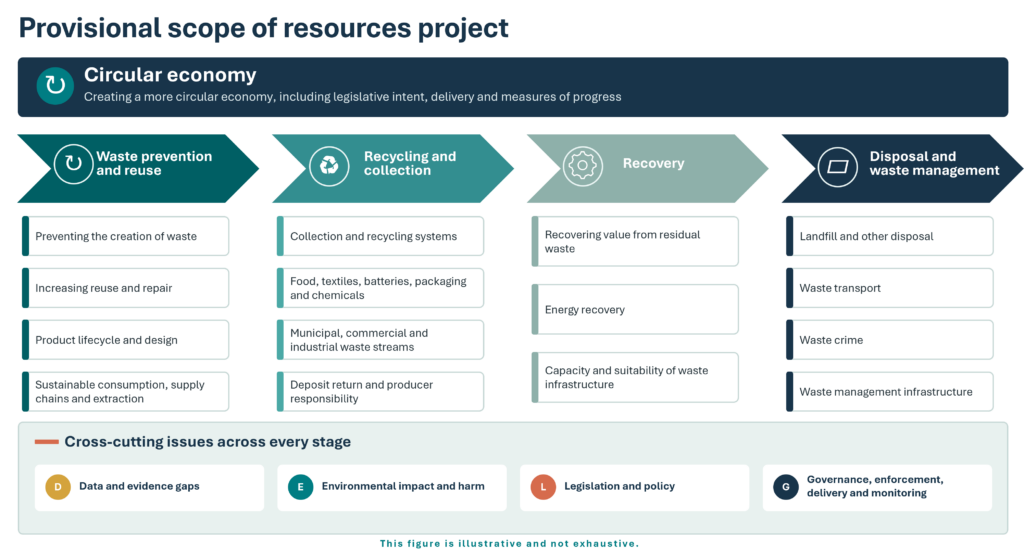
Environmental Standards Scotland (ESS) is gathering evidence about how environmental law relating to waste, resources and the circular economy is working in Scotland. Resources (Figure 1) forms one of four priorities identified in ESS Strategy 2026-2031. This is a topic where there is currently a lot of change taking place with a variety of important pieces of policy and legislation being developed and implemented, for example through Scotland’s Circular Economy and Waste Route Map, and Scotland’s Circular Economy Strategy.

There are recognised areas where improvement and further progress is required. Scotland has not met earlier targets for food waste reduction and recycling of household waste and is at risk of missing targets for recycling of all waste and the percentage of waste that goes to landfill [1] [2]. Consequently, new statutory targets are being developed following the passing of the Circular Economy (Scotland) Act 2024.

ESS is therefore seeking evidence on compliance with and the effectiveness of environmental law from stakeholders to enable us to focus its future work on this topic.

ESS welcomes evidence from respondents based on professional or organisational experience, research, monitoring, regulatory activity and practical service delivery. We also welcome evidence relating to potential impacts (including cumulative impacts) on the environment and/or public health and the urgency with which improvement is required. You do not need legal expertise or knowledge of specific legislation to respond.

The deadline for submissions is 17 January 2027. Please fill in the online survey form or you are welcome to email your response to callforevidence@environmentalstandards.scot.

We would be pleased to receive information with fewer than 30 pages where possible but please link to more extensive published reports where relevant.


[1] Scottish Environment Protection Agency (SEPA). Household waste data [Internet]. Stirling: SEPA; [cited 2026 Oct 29]. Available from: https://www.sepa.org.uk/environment/waste/waste-data/waste-data-reporting/household-waste-data/ 

[2] Scottish Environment Protection Agency (SEPA). Waste data for Scotland [Internet]. Stirling: SEPA; [cited 2026 Oct 29]. Available from: https://www.sepa.org.uk/environment/waste/waste-data/waste-data-reporting/waste-data-for-scotland/ 

  • 03 November 2026

2. Why are ESS seeking evidence?

In line with the priorities identified in our strategy, ESS is gathering evidence on the topic of resources to understand:

  • whether the law is effectively achieving its intended environmental outcomes
  • whether public authorities are complying with environmental law
  • how effectively environmental law is being implemented, applied, monitored and enforced
  • whether future ESS scrutiny could add value

This is a call for evidence, not a consultation on a policy proposal or ESS’ future work plan. The evidence gathered will help ESS identify and assess potential issues for further scrutiny. It will not by itself determine which issues ESS will investigate or include in its future work programme. Any decisions about next steps will also take account of ESS’ statutory remit, existing evidence and published prioritisation criteria.

  • 03 November 2026

3. What is in scope?

ESS’ Strategy identifies the resources priority as ‘securing sustainable resource use, reducing waste and developing a circular economy’. We are taking a broad approach to what could be included within this topic providing it is consistent with our duties to scrutinise compliance with, and the effectiveness of, environmental law and how it is being implemented. While we develop our own definition of resources, we have drawn from definitions used elsewhere including the Scottish Government, UK Government and the EU. We have provisionally set out the following sub-topics that sit within resources (Figure 1).

Respondents do not need to identify where an issue fits before submitting evidence.

Some relevant areas of environmental law may be reserved to the UK Parliament. Where this is the case, we still welcome evidence about such matters where they affect environmental outcomes in Scotland, although the actions that ESS is able to take may be limited.

provisional scope of the resources project and the cross-cutting issues affecting all stages of waste management

Figure 1: provisional scope of resources project

  • 03 November 2026

4. What type of evidence are we looking for?

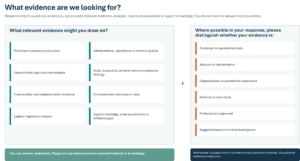
Respondents are invited to answer only those questions for which they can provide relevant evidence, analysis, practical experience or expert knowledge. Figure 2 provides an overview of suitable evidence.

The types of evidence sought in responses and the categories respondents should use to describe that evidence

Figure 2: evidence sources and classifications for consultation responses

  • 03 November 2026

5. Definitions of key terms

For the purpose of this call for evidence, we have provided definitions for the following terms.

Legislative framework: includes environmental legislation, statutory duties and targets, regulations and legally required plans or programmes. It also includes how these requirements are implemented, monitored and enforced by public authorities.

Compliance: whether a public authority is meeting a relevant legal requirement or statutory duty.

Implementation and application: how legal requirements are put into practice, administered, monitored and enforced. 

Effectiveness: whether the law, and its implementation, are producing the environmental outcomes they are intended to achieve. Effectiveness may include whether the framework sustains or changes behaviour or practices that help to reduce environmental harm, promote stronger outcomes for the environment and people’s health, and helps to avoid unintended consequences.

Legislative gap: an area in which respondents consider that existing environmental law does not adequately address a significant environmental risk.

Public authorities: For the purposes of ESS, public authorities are persons, bodies or organisations exercising functions of a public nature in Scotland, including the Scottish Government, its agencies, local authorities, health and transport authorities, and other organisations carrying out public functions.

6. How to respond

Please submit responses by 17 January 2027 using:

The same email address may be used for queries or to submit supporting material.

To support proportionate analysis, please keep your main response to fewer than 30 pages where possible. You may provide links or references to longer reports, datasets, academic literature or other supporting evidence.

7. How we will use and publish responses

We will analyse the responses to identify evidence that falls within our remit, which includes scrutinising public authorities’ compliance with environmental law and the effectiveness of environmental law in Scotland.

We will then consider the criteria identified in our Strategy during analysis and prioritisation:

  • impact – the size and risk of the potential environment and/or public health harm
  • character and scope – assessing recent performance trends and whether an issue is systemic or longstanding, as well as the spatial distribution
  • neglect – whether there has been action taken recently on the issue, or whether action is planned
  • added value – assessing the contribution ESS can make, considering the work others are doing to address concerns

We intend to publish a summary of the evidence received, the main evidence gaps identified and an explanation of how the evidence has informed the next stage of ESS’ work on resources. We expect to publish this in spring 2027 and will notify respondents when it is available.

A response to this call for evidence will not be treated as a representation requesting an investigation. Requests for an investigation are considered through a separate process.

8. Privacy and information handling

Data controller

ESS is the data controller for the personal data you provide through our online Smartsheets form.

FOI and FOISA

Information from the responses received will be collated and summarised. Information will not be directly quoted and attributed to individuals or organisations for official publication without your prior permission. However, we may publish or disclose the information you provide, in accordance with the access to information regimes. These are primarily the ‘Freedom of Information (Scotland) Act 2002’ (FOISA) and the ‘Environmental Information (Scotland) Regulations 2004’ (EIRs).

ESS – as a public authority – has obligations under FOISA and EIRs to disclose information in response to a request made under these laws unless an exemption applies. If you want the information you provide to be treated as confidential, please provide your reasoning for why this information should be treated as confidential. ESS will take full account of your explanation if a request for disclosure of the information is received. However, ESS cannot give an assurance that confidentiality can be maintained in all circumstances.

Please do not provide any information that relates to an identified or identifiable individual. If this is unavoidable, please anonymise in such a way that individuals are not identifiable. Further information regarding the anonymisation of personal data, and the issues you need to consider to ensure anonymisation is effective, can be found at the ICO’s website.

Where personal data is provided, ESS will hold and process this in accordance with our privacy notice on ESS website.  Providing information to ESS is not intended to affect either party’s ownership of its intellectual property rights.

What personal data we collect

At the beginning of the survey, we will ask:

  • for your email address
  • your main role or area of expertise
  • whether you are responding in a personal capacity, on behalf of an organisation, on behalf of a network
  • if you are responding on behalf of an organisation or a network we will ask for the name of the organisation or network
  • whether ESS can contact you for further clarification, or about related future work
  • whether you would like to subscribe to our ESS newsletter

We will be asking open questions with free text answer boxes. Please do not include any information that could directly identify you in these boxes. If we receive any responses which include information that we think may directly identify you, we will seek to remove this information.

How we use your data (purposes)

We ask for this information so that we can provide better environmental scrutiny for the public. In this instance, we will use the data to inform the prioritisation of our analytical work on our strategic topic of resources. The public output from this call for evidence will be a summary of responses that will be anonymised which means that nobody who provides a response to this call will be identifiable from the information we publish.

Legal basis for processing personal data

Under data protection law, we need to tell you what our legal basis is for processing the data you are providing to us. Our legal basis is the performance of a task in the public interest, or in the exercise of our official scrutiny functions as per the UK Withdrawal from the European Union (Continuity) (Scotland) Act 2021.

Data processors and other recipients of personal data

The call for evidence is hosted through an online platform called Smartsheets who store information on their own EU servers. ESS subscribe to this platform and will delete any personal data in line with the retention and disposal periods outlined below.

  • we will only share anonymised data publicly and no individual or organisation will be identifiable from this data
  • we do not sell data to anyone else, nor do we provide it for companies to use for marketing or advertising purposes.
  • we would only share personal data with any other organisation if we are required to do so by law

International data transfers and storage locations

Storage of data by Smartsheets is provided through secure servers located in the EU. We have security procedures in place to make sure your information is safe and to make sure it doesn’t get lost or accessed by anyone who doesn’t need to see it.

Retention and disposal policy

Your data will be held by ESS for 2 years from the closure of the call for evidence. This will allow us to use the data to improve the services we provide and after 2 years we will safely delete it.

Smartsheets will securely erase the data held on its system when instructed to do so by ESS if the data has served its intended purpose.

How we keep your data secure

Both ESS and Smartsheets have security procedures in place to make sure your information is safe and to make sure it doesn’t get lost or accessed by anyone who doesn’t need to see it. This includes only allowing authorised persons access to your data using methods like password protection, encryption and making sure that the servers we use are secure.

Your rights as a data subject

By law, data subjects have a number of rights, and this processing does not take away or reduce your rights under the UK General Data Protection Regulation and the Data Protection Act 2018.

These rights are:

  • the right to obtain copies of information – individuals have the right to ask for a copy of any information about them that is stored or used
  • the right to have information corrected – individuals have the right to ask for any information held about them that they think is inaccurate, to be corrected
  • the right to limit how the information is used – individuals have the right to ask for any of the information held about them to be restricted – for example, if they think inaccurate information is being used
  • the right to object to the information being used – individuals can ask for any information held about them to not be used. However, this is not an absolute right, and continued use of the information may be necessary, with individuals being advised if this is the case
  • the right to have information deleted – this is not an absolute right, and continued use of the information may be necessary, with individuals being advised if this is the case

Comments or complaints

Anyone unhappy or wishing to complain about how personal data is used as part of this call for evidence should contact enquiries@environmentalstandards.scot in the first instance or write to:

Environmental Standards Scotland

Thistle House

91 Haymarket Terrace

Edinburgh

EH12 5HD

Anyone who is still not satisfied can complain to the  Information Commission .

Their postal address is:

Public Advice and Data Protection Complaints Service
ICO Head Office
4th Floor, No.3 Circle Square
5 Hawkshaw Street
Manchester
M1 7BL

9. Consultation questions

Please find a list of the consultation questions that are in our Smartsheet form below.

Part 1: information on respondent

a) Email address

b) What is your main role or area of expertise relevant to this call for evidence?

  • policy or legislation
  • regulation or enforcement
  • operational or service delivery
  • data or analysis
  • scientific or technical practice
  • monitoring or assessment or evaluation
  • academic research
  • legal
  • environmental advocacy
  • community or lived experience
  • industry or commercial
  • other (optional free text box)
  • prefer not to say

c) Are you responding:

  • in a personal capacity
  • on behalf of an organisation
  • on behalf of a network or group

d) Name of organisation, network or group (if responding on behalf of)

e) May ESS contact you if clarification or further information is needed about this response and to inform you when the summary is published?

  • yes / no

f) May ESS contact you about future work directly related to this call for evidence?

  • yes / no

g) Would you like to subscribe to ESS’ newsletter (optional and you can unsubscribe at any time)

  • yes / no

Part 2: topic specific questions

For the purposes of this call for evidence, when we refer to the legislative framework it includes environmental legislation, statutory duties and targets, regulations and legally required plans or programmes. It also includes how these requirements are implemented, monitored and enforced by public authorities.

When responding, please consider including the following information where possible:

  • whether there are concerns that a public authority may not be meeting relevant legal requirements
  • whether there are effectiveness issues – by effectiveness, we refer to whether the legislation is working as intended and delivering its intended (or meaningful) improvements in this area
  • whether your concern is about implementation, enforcement, legislative gaps, data availability, monitoring or another matter
  • the law, statutory duty, target or public authority it concerns
  • the environmental impact, outcome or risk
  • the significance and geographic spread of the issue (isolated or large scale)
  • any actions which are already being taken or planned
  • any further evidence you can point us towards

Question 2:
What evidence can you provide to support your concerns about compliance with, or effectiveness of, the current legislative framework in Scotland for the following areas: Please refer to the points above when responding and note there is not there is no need to respond to all areas, only to those you have evidence you are willing to share. 

  1. waste management (including transport and crime)
  2. recovery, including energy recovery
  3. recycling and collection
  4. waste prevention and reuse
  5. creating a more circular economy
  6. the effectiveness of the waste, resources and circular-economy framework collectively for delivering intended environmental outcomes in Scotland

Part 3: cross cutting questions

  1. In Figure 1 we suggested sub-topics that would fall within the scope of our resources project. Does the proposed scope omit or incorrectly categorise any relevant area? Please identify the area, explain the proposed change and provide supporting evidence where available.
  2. Do you have concerns regarding any divergence between environmental law applying in Scotland and relevant EU, UK or international standards that may risk negative environmental outcomes? Please identify the relevant measures, explain how harm may arise, and provide supporting evidence.
  3. Please provide evidence of any data, evidence, legislative or enforcement gaps that act as barriers to the sustainable management of Scotland’s resources (Figure 1 provides scope). This could include gaps in the information available to assess resource use and outcomes, as well as gaps in legislation or its enforcement that may affect compliance, implementation or effectiveness.

For each gap identified, please provide as much information as possible on:

  • the issue, question or challenge that cannot currently be adequately addressed
  • the data, evidence, legislative provision or enforcement mechanism that is missing, insufficient or unclear
  • the organisations involved or responsible (where known)
  • the impact of the gap on the compliance, implementation or outcomes
  • any evidence supporting your view
  • any suggested actions to address the gap.

Part 4: open question

  1. Is there a significant issue, body of evidence or emerging risk within the waste, resources and circular-economy system that is not adequately covered above? Please explain its environmental significance, provide or reference supporting evidence, and indicate the potential compliance and effectiveness failure if known.
Back to top