• 17 August 2026

Glossary

BACI – Before After Control Impact

CFP – Common Fisheries Policy

CEE – Collaboration for Environmental Evidence

ESS – Environmental Standards Scotland

MPA – Marine Protected Area

MSY – Maximum Sustainable Yield


  • 17 August 2026

1. About this report

1.1

Environmental Standards Scotland’s (ESS) strategic plan 2022-25 identified several analytical priorities. One of these is ‘developing a better understanding of threats to the marine environment’. Following systematic scoping and evaluation, seafloor integrity was prioritised because of its importance for achieving overall “Good Environmental Status” under the UK Marine Strategy and its increasing exposure to human and climate-related pressures.

1.2

Section 20 of the UK Withdrawal from the European Union (Continuity) (Scotland) Act 2021 sets out the scope of ESS’ functions. ESS’ remit is to:

  • ensure public authorities, including the Scottish Government, public bodies and local authorities, comply with environmental law
  • monitor and take action to improve the effectiveness of environmental law and its implementation

1.3

ESS has prepared this technical report as part of its remit to assess compliance with environmental law, the effectiveness of environmental law or how it is implemented and applied. The relevant environmental law for this work is the Marine Strategy Regulations 2010.

1.4

This report presents the results of a systematic rapid review to synthesise current evidence on how non-spatial fisheries management actions affect benthic habitats. Technical reports are used by ESS to present detailed analytical evidence that underpins and inform our scrutiny work and decision-making. This technical report will be of interest to academics, public bodies and authorities responsible for marine management and environmental targets, and anyone interested in the scrutiny of these measures. ESS has used this work as part of its broader evidence base in examining how effectively Scottish public authorities are fulfilling their duties under the Marine Strategy Regulations 2010.


Suggested citation

Rouse, S. & Bradley, L. (2026). Effects of non-spatial fisheries management under the UK Marine Strategy on seafloor integrity – a rapid evidence review. Environmental Standards Scotland Technical Report. Available at Environmental Standards Scotland

  • 17 August 2026

2. Introduction

2.1

The EU Marine Strategy Framework Directive was transposed into UK legislation through the Marine Strategy Regulations 2010 (hereafter referred to as ‘the 2010 Regulations’). The 2010 Regulations place an obligation on the Secretary of State and devolved administrations to take measures to achieve or maintain Good Environmental Status (GES) in the marine environment by 2020. To deliver GES, the 2010 Regulations require the UK to produce, and periodically update, a marine strategy, consisting of three parts. Part One provides an assessment of the status of marine waters, defines the UK’s interpretation of GES characteristics and sets associated targets and indicators. Part Two establishes a monitoring programme to track progress against those targets and indicators, while Part Three describes a ‘Programme of Measures’ to achieve or maintain GES.

2.2

Under the Part One assessment, GES criteria, targets and indicators are defined for 11 descriptors. For descriptor 6 (seafloor integrity), the first Part One assessment published in 2012 defined five GES criteria: habitat distribution, habitat extent, habitat condition, physical damage, and the condition of the seafloor (“benthic”) community. Individual targets were then set for the GES criteria across different seafloor habitats. In the updated Part One assessment (2019), GES criteria for seafloor integrity were revised to the following four: (1) spatial extent of physical loss; (2) extent of adverse effects; (3) spatial extent of habitat types adversely affected by physical disturbance; and (4) habitat condition. Under the 2010 Regulations, the status of marine waters is reassessed every six years, using these criteria and targets to determine whether GES has been achieved for the seafloor integrity descriptor as part of the benthic habitats assessment. The most recent assessment was published in 2026, following the previous assessment in 2019.

2.3

Part Three of the UK Marine Strategy lists the actions or ‘measures’ that will be implemented by the Scottish Government (and other UK administrations) to achieve GES targets for the criteria set out in Part One. For the seafloor integrity descriptor, several of the listed measures aim to manage and reduce pressure from fishing activity. This includes spatial restrictions on fishing activity e.g. through Marine Protected Areas (MPAs), and non-spatial restrictions such as catch limits, gear modifications and effort reduction. Non-spatial restrictions are included as part of the following measures across the 2015 and updated 2025 Programme of Measures:

  • the Prohibition of Fishing for Scallops (Scotland) Order 2003
  • the Common Fisheries Policy
  • the Fisheries Act 2020

2.4

The Common Fisheries Policy (CFP) and the Fisheries Act 2020 establish broad fisheries management frameworks that provide for the implementation of a range of management measures, including catch limits, effort controls, technical conservation measures and measures designed to achieve Maximum Sustainable Yield (MSY) and an ecosystem-based approach to fisheries management. In contrast, the Prohibition of Fishing for Scallops (Scotland) Order 2003 establishes specific technical restrictions on scallop dredging activity, including limits on dredge numbers, gear design restrictions and temporal controls on fishing activity in certain areas.

2.5

To evaluate whether the UK Marine Strategy Programme of Measures, and subsequent updates, can be considered sufficient to achieve GES, it is necessary to establish whether scientific evidence indicates that the included measures are effective in delivering progress against the seafloor integrity criteria. On this basis, ESS has assessed published research on the effectiveness of non-spatial fisheries measures associated with the UK Programme of Measures for improving benthic habitat status.

2.6

The assessment uses a systematic review of 12 studies from the UK, Continental Europe, and the Mediterranean published between 2008 and 2026. The review evaluates evidence relating to the effects of non-spatial fisheries management measures on benthic habitats, including direct measures of habitat condition, benthic community status and biomass, as well as indirect indicators of benthic pressure such as trawling intensity, seabed disturbance and the extent of management measures. The review considers the extent to which different non-spatial management measures are associated with reductions in benthic impacts, and identifies factors that influence their effectiveness, including effort displacement, compliance, and the type of fishing activity being managed. The analysis forms part of broader scrutiny by ESS to examine how effectively Scottish Ministers and other public authorities are fulfilling their duties under the 2010 Regulations.

  • 17 August 2026

3. Methodology

Protocol

3.1

To synthesise available evidence on the effect of non-spatial fisheries management measures under the CFP, the Fisheries Act 2020 and the Prohibition of Fishing for Scallops (Scotland) Order 2003, a systematic literature review was conducted. To enable a rapid assessment, the review was limited to primary research published in peer-reviewed academic literature.

3.2

The review followed the principles set out in the Collaboration for Environmental Evidence (CEE) Guidelines and Standards for Evidence Synthesis in Environmental Management.[1] These guidelines provide a robust, evidence-based framework for the conduct of systematic reviews addressing environmental topics. The CEE protocol was selected because it has been specifically developed for application in environmental management and is widely endorsed as best practice for producing rigorous and transparent evidence syntheses in this field.

3.3

To ensure the credibility of findings, systematic reviews must follow clearly defined methodological standards, including the systematic identification and mitigation of potential sources of bias within both the evidence base and the review process itself. The CEE protocol promotes transparency through the clear documentation of key methodological components such as inclusion and exclusion criteria, search strategies, data extraction procedures, and synthesis methods. By supporting methodological rigour and transparency, the CEE protocol’s structured framework strengthens the reliability of findings and conclusions, encouraging consistency and clarity in the reporting methods and results. In doing so, it enables independent replication of the review and provides a solid foundation for future updates or extensions that build on its evidence base.

3.4

The CEE protocol is subject to ongoing development, with continuous efforts to refine and improve the guidelines and standards in evidence synthesis methodology. This report specifically follows the principles set out in Version 5.1 of the CEE Guidelines and Standards for Evidence Synthesis in Environmental Management.[1]

Limitations

3.5

While the CEE protocol offers a structured and reproducible approach that improves the reporting quality of systematic reviews, certain limitations are nonetheless inherent to the process. Publication bias is a well-recognised limitation in systematic reviews, arising from the tendency for studies with positive or statistically significant findings to be published more frequently than those reporting negative or null results. This selective availability of evidence can skew the overall understanding of a topic by overrepresenting favourable outcomes and underrepresenting studies that report little, no or negative results. Consequently, the evidence base may present an unbalanced view, potentially leading to biased conclusions even when a systematic review is conducted rigorously.

3.6

Grey literature can help address publication bias by capturing evidence that may not be published through traditional academic channels, such as government reports, technical reports, policy documents and environmental assessments. However, due to project time constraints, this review was restricted to peer-reviewed academic literature and did not include a systematic search for grey literature. Consequently, relevant evidence contained within government reports, technical documents and other non-academic sources may not have been captured, representing a potential limitation of the evidence base and increasing the risk of publication bias.

3.7

Another important limitation concerns the quality and validity of the included studies. Even when studies meet the pre-defined eligibility criteria, they may still contain methodological flaws – such as weak study design, poor reporting, or insufficient detail on data collection and analysis – which can affect the strength and reliability of their findings. These weaknesses, if not accounted for, have the potential to influence the overall conclusions of the review. Where such flaws are evident, they will be noted and discussed within the synthesis to provide context and ensure transparency in how the evidence has been interpreted.

3.8

A further challenge in conducting systematic reviews across environmental topics is the heterogeneity of study designs, methodologies, and outcome measures. Studies often vary widely in terms of spatial and temporal scale, data collection methods, ecological indicators, and how outcomes are measured and reported. This diversity reflects the complex, context-specific nature of environmental systems but can significantly reduce the ability to draw clear, comparable conclusions across studies. To address this challenge, this review applies a standardised framework for data extraction and categorisation, grouping studies by shared characteristics (e.g. geographic region, or methodological approach), and explicitly accounting for differences in study quality and design in the interpretation of results.

3.9

The protocol requires detailed documentation at every stage of the review process and recommends independent double screening of all records during both the title and abstract screening, full-text screening, and data extraction stages. This is designed to maximise consistency, reduce bias, and enhance the overall reliability of the review. However, due to the practical constraints of this project, full double screening and data extraction were not feasible. Instead, a subset of 10% of studies were independently screened by a second reviewer at both the title and abstract stage, and again at the full-text stage. This served as a consistency check to ensure that the inclusion and exclusion criteria were being applied and interpreted consistently. Any discrepancies that arose during this process were resolved through discussions between reviewers to reach a consensus. This approach represents a pragmatic compromise which maintains a reasonable level of rigour under constrained conditions.

3.10

Finally, systematic reviews provide a snapshot in time, capturing the state of knowledge up to the point when the final searches are completed. In rapidly evolving fields, such as marine conservation and management, the evidence base is dynamic and continually expanding, meaning that new and potentially relevant studies may emerge after this review has been conducted. Without regular updates, the conclusions of this review may eventually become outdated, particularly given the time lag between conducting this review and its eventual publication, which could result in the exclusion of recent findings. This could limit the report’s usefulness as a source of evidence for informing policy or management decisions over the longer term (e.g. 5 to 10 years). To maintain relevance, this systematic review should ideally be revisited and updated as new evidence becomes available.

Research question

3.11

This report addresses the following question, expressed using the PICO (Population, Intervention, Comparator, Outcome) framework:

Within benthic ecosystems subject to fishing pressure [P], to what extent are non-spatial fisheries management measures implemented under the Common Fisheries Policy, Fisheries Act 2020 and the Prohibition of Fishing for Scallops (Scotland) Order 2003 [I] associated with reduced benthic habitat impacts and improved seafloor integrity [O]?

Eligibility criteria

3.12

Eligibility criteria for the inclusion of studies are detailed in Table 3.1.

Table 3.1: Inclusion and exclusion criteria

Criteria Inclusion/Exclusion Rule
Language Only literature published in the English language was included in the review.
Publication Type From academic sources, peer-reviewed journal articles and review articles were included, while standalone data sets were excluded.
Geographical Scope Studies were included if they were conducted in marine environments around the UK and Continental Europe. These regions were included because each region’s legislation governing marine protection has been derived from the EU Marine Strategy Framework Directive, and/or they have a comparable marine environment to Scotland

Studies conducted outside of this geographic scope – including those based in the Americas, Asia, Africa, Oceania, or European overseas territories (e.g. St. Helena, Azores, Madeira, and the Canary Islands) – were not included.

Study Focus Studies were included if they evaluated the effects of non-spatial fisheries management measures on benthic habitats, benthic communities, seafloor integrity, seabed disturbance, or related indicators of benthic impact. Studies reporting direct ecological responses, pressure-based indicators, or management measures intended to reduce benthic impacts were eligible.

Studies focusing exclusively on spatial fisheries restrictions, or on economic, social, governance or fish stock outcomes without a benthic habitat-related outcome, were excluded.

Search strategy

3.13

The search strategy was developed through an iterative process. Initial search terms were identified from the fisheries management measures relevant to the review question, including terms relating to effort controls, catch limits, gear restrictions and modifications, seasonal closures, and MSY. These terms were refined through exploratory searches to identify additional terminology used within the literature and to improve the relevance and sensitivity of the final search strategy.

3.14

Search terms representing benthic habitats and seafloor integrity were adapted from those developed for ESS’ previous systematic review of the effects of Marine Protected Areas on seafloor integrity [2]. The list included broad terms relating to benthic habitats, seabed habitats, benthic communities and seafloor integrity, alongside relevant habitat-specific terminology. Terms were reviewed and refined during testing to remove those that consistently returned irrelevant results and to improve the precision of the final search strategy.

3.15

Search terms were developed to represent the population and intervention components of the review question, ensuring the search captured studies examining non-spatial fisheries management measures and their effects on benthic habitats and associated biological communities. Search terms for the comparator and outcome elements were not included. Comparators were often implicit (e.g. before–after comparisons, alternative management regimes or the absence of management measures) and could not be readily translated into searchable terms. Similarly, outcomes of interest encompassed a wide range of ecological and pressure-based indicators, including benthic habitat condition, benthic communities, seabed disturbance and seafloor integrity. Restricting the search to specific outcome terms risked excluding relevant studies that used different terminology or assessed benthic impacts indirectly. To maximise search sensitivity, the search strategy therefore focused on the population and intervention components only. Final search terms are provided in Appendix 1.

3.16

Within each category, search terms were combined using the Boolean operator OR. The population and intervention categories were then combined using the Boolean operator AND so that only studies addressing both components were retrieved. The wildcard operator (*) was used where appropriate to capture variations in word endings and alternative spellings, increasing the sensitivity of the search. The full search string is provided in Appendix 2.

Academic database search

3.17

Searches were conducted using the Web of Science platform, accessed through the National Library of Scotland. The search was undertaken within the Web of Science Core Collection, which indexes peer-reviewed literature across the natural and social sciences and contains records dating from 1900 onwards.

3.18

Application of the final search string returned 272 records. Following export of records and the removal of duplicates, 251 unique records remained for title and abstract screening.

Study/evidence selection

3.19

The systematic review platform CADIMA was used to manage the title and abstract screening process [3]. Bibliographic records were exported as .ris files and imported into the platform, where both automatic and manual de-duplication were performed. Titles and abstract screening were carried out within CADIMA using predefined inclusion and exclusion criteria. All records were initially screened by a single reviewer. In line with the CEE protocol, a subset of 10% of records was independently screened by a second reviewer to assess consistency in the application of the inclusion and exclusion criteria. Any discrepancies in decisions were automatically flagged by the system. These differences were resolved through discussion between the screeners to reach a consensus, ensuring a consistent interpretation of the pre-defined inclusion and exclusion criteria.

3.20

Following the completion of title and abstract screening, all articles meeting the inclusion criteria at that stage were retrieved for full-text screening. Again, a subset of 10% of full texts was independently screened by a second reviewer to assess consistency in the application of the inclusion and exclusion criteria.

3.21

After all stages of screening were completed, a total of 12 studies met the inclusion criteria and were retained for full analysis in the review.

Data extraction

3.22

A standardised data extraction form was developed to capture relevant information from the included studies. In addition to CADIMA’s default bibliographic fields, such as author details, title, and publication year, the following data items were extracted from each study where available:

  • study location:
    • water body: named marine or coastal feature (e.g. North Sea)
    • general region: broader geographic area (e.g. western Scotland)
  • fisheries and management characteristics:
    • fishery type and target species
    • fishing gear or fleet characteristics
    • fisheries management intervention(s) assessed (e.g. effort controls, catch limits, gear restrictions, gear modifications, seasonal closures, certification schemes, or MSY-based management)
  • study setting and design:
    • study aim (primary research objective e.g. assess recovery, evaluate biodiversity change)
    • study design (e.g. Before After Control Impact (BACI), observational, modelling or scenario analysis)
    • study period
    • comparator or reference condition
  • benthic response and outcomes:
    • benthic response variable(s) assessed
    • response type (measured, assessed, modelled or proxy indicator)
    • direction of effect (positive, negative, mixed or no effect)
    • effect size or quantitative findings, where reported
    • evidence category (direct ecological response, pressure-based response, or management proxy)
  • interpretation and implications
    • key findings
    • study limitations and sources of uncertainty
    • management implications
    • additional notes relevant to interpretation of results
  • additional information
    • references identified through snowball searching
    • internal validity, assessed as high, moderate or low
    • external validity, assessed as high, moderate or low
Critical appraisal

3.23

A formal, risk-of-bias assessment was not undertaken for this review. Instead, critical appraisal was embedded within the data extraction process. All included studies were assessed by an experienced researcher with domain expertise, who assessed study methodology, design, and reporting as part of the extraction process. Where potential limitations or concerns relating to study validity (e.g. lack of appropriate controls, limited replication, or unclear analytical methods) were identified, these were recorded qualitatively in the data extraction framework. These observations were subsequently considered during evidence synthesis and interpretation of findings but were not used as formal exclusion criteria or to generate quantitative study quality scores.

  • 17 August 2026

4. Results

4.1

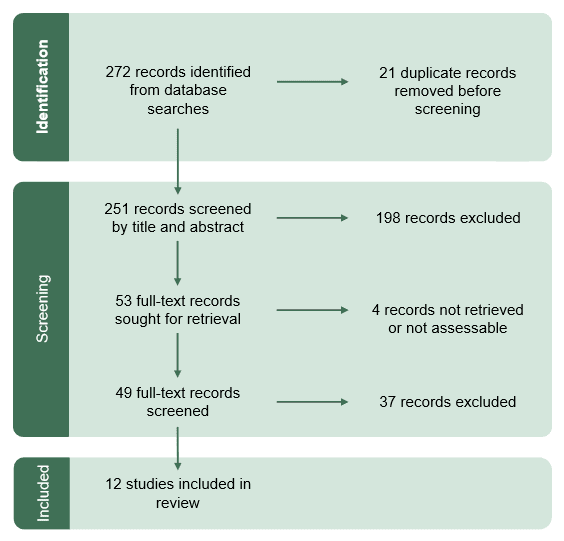
A total of 251 unique records were identified. Of these, 198 records were excluded following a review of titles and abstracts, leaving 53 records for full-text screening. Twelve full texts met the inclusion criteria and were included in this review (Figure 4.1).

4.2

The final 12 studies included in the review are listed in Appendix 3.

PRISMA flow diagram showing the study selection process for a systematic review. Database searches identified 272 records, with 21 duplicates removed, leaving 251 records for title and abstract screening. Of these, 198 records were excluded. Fifty-three full-text records were sought for retrieval, with 4 not retrieved or assessable. Forty-nine full-text records were screened, and 37 were excluded. The review ultimately included 12 studies.

Figure 4‑1. PRISMA flow diagram shows the study selection process for this systematic review. The diagram details the number of records identified, screened, excluded, and included at each stage of the review.

4.3

The 12 studies included in this review were conducted across a range of European marine regions, with the North Sea being the most frequently represented. Eight studies included case studies on fisheries operating in the North Sea and adjacent waters, including the English Channel and Danish Wadden Sea. Two studies were conducted in the Mediterranean Sea, two in the Baltic Sea region (including the Kattegat and Skagerrak). The Celtic Seas or West of Scotland region were represented in two studies. One study evaluated fisheries management scenarios across multiple European marine regions, including the North Sea, Bay of Biscay and Mediterranean Sea.

4.4

The evidence base comprised a mixture of empirical field studies, before–after impact assessments, comparative reviews and modelling studies. A range of fisheries management measures was represented. Effort-control measures, including fishing effort reduction and management consistent with MSY, were the most commonly assessed interventions. Other management approaches included temporal closures, quota controls, technical gear restrictions and gear modifications, habitat-credit systems, certification schemes, and combinations of spatial and non-spatial measures. Several studies evaluated integrated management packages comprising multiple interventions operating simultaneously, reflecting the integrated nature of contemporary fisheries management.

4.5

Studies ranged from short-term assessments of seasonal fisheries closures to ecosystem-scale evaluations of fisheries management scenarios and long-term management strategies. Of the 12 included studies, eight primarily used simulation, ecosystem or bioeconomic modelling approaches to predict the effects of fisheries management interventions, three were empirical field studies that observed effects before and after fisheries management interventions and one was a comparative review of fisheries management systems. This means that most studies assessed benthic outcomes indirectly through modelled ecological responses or pressure-based indicators, with relatively few studies measuring direct changes in benthic habitats or communities. Within each category of study type (modelled ecological, pressure-based indicators and direct biological response), a variety of response/outcome metrics were used.

4.6

In the four studies that assessed pressure-based outcomes, metrics included trawling footprint, swept area and fishing pressure across habitat types. One study combined pressure-based, physical habitat and modelled biological indicators, including trawling footprint, sediment mobilisation, benthic biomass and benthic community longevity. Two studies measured direct biological responses, and used changes in benthic abundance, biomass, diversity and habitat extent as response metrics. The five studies that assessed modelled biological responses used metrics including relative benthic status, benthic community recovery and depletion rates, biodiversity indicators and food-web structure metrics. However, the biodiversity and food-web indicators were generally derived from ecosystem-scale models in which benthic taxa were aggregated with other functional groups, reducing the specificity of these metrics as measures of benthic habitat condition.

4.7

Evidence of change following implementation of non-spatial fisheries management measures was reported in 10 of the 12 included studies, although the direction and magnitude of effects varied considerably between intervention types and response metrics. Four studies reported predominantly positive benthic responses to fisheries management interventions,[4-7] four reported mixed responses, [8-12] one reported no evidence of improvement,[13] and one reported only temporary positive effects that were not sustained following the resumption of fishing activity.[14] The remaining study compared the use of management practices intended to limit seabed habitat impacts in certified and non-certified fisheries rather than assessing a benthic outcome directly.[15]

4.8

Positive responses were most commonly associated with gear modifications and effort-reduction measures, and included reductions in trawling footprint, sediment mobilisation, seafloor pressure, and modelled impacts on benthic communities, as well as improvements in biodiversity and benthic sustainability indicators.

4.9

Four studies reported mixed outcomes. In these studies, the direction and magnitude of benthic responses varied between management scenarios, habitat types, geographic regions or benthic indicators. Several studies found that reductions in fishing pressure in one area could be partially offset by changes to fishing behaviour, redistributing effort to other areas, resulting in both positive and negative benthic outcomes within the same assessment. Mixed responses were also observed where management measures improved some indicators of benthic condition while worsening others, or where outcomes differed according to local ecological context.

4.10

One study found no evidence that the fisheries management measures assessed had resulted in an improvement of the benthic status, reporting continued declines in mussel biomass and mussel bed extent despite the management regime in place.[13] A further study reported short-term improvements in epibenthic biomass and community structure during a seasonal closure period, but these effects diminished following the resumption of fishing activity, indicating limited evidence of lasting ecological recovery.[16]

4.11

The direction of reported change also varied according to the type of benthic response measured. Studies using pressure-based indicators, such as trawling footprint, swept area or fishing pressure, more frequently reported reductions in benthic impact. In contrast, studies assessing direct biological responses of benthic habitats and communities were fewer in number and generally reported weaker or less consistent evidence of ecological improvement. Modelled biological responses, including relative benthic status, benthic recovery potential and biodiversity indicators, typically predicted positive but context-dependent responses to fisheries management measures.


  • 17 August 2026

5. Discussion

5.1

The evidence base identified through this review provides moderate support for the effectiveness of non-spatial fisheries management measures in reducing pressures on the seabed and/or improving benthic habitat status to deliver GES. However, it provides less consistent evidence that such measures result in measurable improvements in benthic habitats or communities. This is because of the predominance of pressure-based metrics and ecological modelling studies in the identified literature.

5.2

The clearest positive evidence was associated with measures that directly reduced the intensity of benthic disturbance, particularly gear modifications and effort-reduction measures. For example, replacement of conventional beam trawls with pulse trawls was associated with substantial reductions in trawling footprint, sediment mobilisation and modelled impacts on benthic communities.[4] Several modelling studies also predicted improvements in benthic status or biodiversity indicators under scenarios involving reduced fishing mortality or management consistent with MSY. Evidence for temporal restrictions and mixed management packages was more variable and frequently influenced by effort redistribution and fisher behavioural responses.

5.3

Approximately half of the studies reported mixed outcomes. In these studies, management effectiveness depended strongly on habitat sensitivity, local ecological conditions, management design and fisher behaviour. Responses often varied between indicators, habitats and geographic regions, demonstrating that the ecological effects of fisheries management interventions are highly context dependent.

Interactions between spatial and non-spatial management

5.4

Although the review focused on non-spatial fisheries management measures, several of the included studies evaluated these measures alongside spatial restrictions or concluded that non-spatial measures were most effective when implemented as part of a broader management package.

5.5

Studies that included both spatial and non-spatial measures concluded that neither approach was sufficient alone to achieve wider ecosystem objectives. Instead, combinations of effort controls, technical measures, quotas and spatial restrictions generally produced stronger improvements in benthic indicators than either type of measure applied in isolation [7, 10, 11].

5.6

This finding is consistent with broader evidence from fisheries management literature, which suggests that local gains achieved through spatial protection can be undermined if fishing effort is displaced elsewhere.[17, 18] The reviewed evidence, therefore, suggests that non-spatial measures should be viewed as complementary to spatial management approaches.

Influence of response metrics on conclusions

5.7

A notable finding of the review is that conclusions regarding management effectiveness depended heavily on the type of benthic response metric used. Most studies did not directly measure changes in benthic habitats or communities. Instead, they relied on pressure-based indicators, modelled biological responses, or broader ecosystem metrics which only indicate benthic condition indirectly.

5.8

The distinction between pressure reduction and ecological recovery is important when interpreting the evidence in relation to seafloor integrity. Studies using pressure-based indicators more frequently reported reductions in benthic impacts following management interventions. By contrast, the limited number of studies measuring direct biological responses generally reported weaker, more variable or less persistent ecological improvements. The two studies that directly measured benthic biological responses found either no evidence of long-term improvement,[13] or only temporary improvements that were reversed following the return of fishing activity.[14]

5.9

The diversity of response metrics used across the studies creates a further challenge when using them to evaluate the strength of evidence supporting the effectiveness of fisheries management measures in delivering GES. Many studies assessed indicators relevant to benthic habitats and seafloor integrity criteria. However, there was no consistent set of metrics or reference points linking observed outcomes directly to achievement of GES under the Marine Strategy Framework Directive, with few studies explicitly evaluating whether management measures would achieve GES or assessed outcomes against established GES thresholds.

5.10

This does not necessarily limit the usefulness of the evidence for this review, because the review question focuses on whether the types of measures included within the UK Marine Strategy are supported by evidence as mechanisms likely to contribute towards improved seafloor integrity. However, the absence of commonly applied GES indicators means that studies often demonstrate the effectiveness of a measure in reducing fishing pressure, seabed disturbance or modelled benthic impacts, without directly demonstrating how those changes relate to progress towards GES. Consequently, the evidence is generally stronger for the effectiveness of particular management measures in reducing known pressures on benthic habitats than it is for determining whether those measures would be sufficient to achieve GES for the seafloor integrity descriptor.

5.11

This issue was explicitly recognised by Baudron et al. (2019), who concluded that “we can identify the scenario most likely to move the ecosystem towards GES, but we cannot prove GES has been reached because thresholds for most indicators do not exist”.[6] Similar challenges were evident across several studies that used ecosystem-scale biodiversity and food-web indicators, in which benthic taxa formed only one component of broader ecosystem models.

Evidence gaps and limitations

5.12

Several limitations within the evidence base should be recognised in the context of this review and with respect to the conclusions relating to the strength of evidence on the effectiveness of non-spatial fisheries management measures. First, the number of studies was relatively small, with only 12 studies meeting the review criteria. Second, the evidence base was dominated by modelling studies, with relatively few empirical investigations measuring ecological responses directly. Eight of the 12 studies relied primarily on simulation, ecosystem or bioeconomic modelling, compared with only three empirical studies and one comparative review. Direct biological measurements of benthic condition were uncommon. Finally, substantial variation in the metrics used to assess benthic responses reduces comparability between studies and makes it difficult to draw direct conclusions about achievement of GES under the Marine Strategy Framework Directive.

5.13

It is possible that relevant evidence may not have been captured because the review was restricted to peer-reviewed literature and a predominantly European evidence base. Inclusion of grey literature and studies from a wider geographic range may have strengthened the evidence base and provided additional insights into the effectiveness of non-spatial fisheries management measures with respect to achieving GES.

Relevance to the UK Marine Strategy Programme of Measures

5.14

Despite the limitations noted above, evidence identified through this review indicates that non-spatial fisheries management measures, including effort controls, MSY-based management, gear modifications, quota controls and temporal restrictions, are supported by scientific evidence as mechanisms that can reduce pressures on benthic habitats and contribute towards improved seafloor integrity. The evidence was strongest for measures that directly reduce seabed disturbance, particularly gear modifications and reductions in fishing effort. However, responses were often context-dependent and influenced by factors such as habitat sensitivity, and effort displacement.

5.15

While the evidence supports the inclusion of these types of measure within the UK Marine Strategy Programme of Measures, several studies suggested that the greatest improvements in benthic indicators were achieved when non-spatial measures were implemented alongside spatial management measures, rather than in isolation. The available evidence, therefore, supports the role of non-spatial fisheries management measures as an important component of a broader management framework for achieving seafloor integrity. The UK Programme of Measures includes both spatial and non-spatial measures for achieving seafloor integrity GES.

5.16

There remain key evidence gaps directly linking observed changes in benthic pressure or condition from non-spatial fisheries management measures to achievement of GES for the seafloor integrity descriptor. Consequently, the current evidence base provides greater confidence in the ability of non-spatial fisheries management measures to reduce pressures on benthic habitats than in their sufficiency, either individually or collectively, to deliver GES. Further empirical research that directly assesses benthic habitat responses against recognised seafloor integrity indicators would strengthen future assessments of the contribution of fisheries management measures (spatial and non-spatial) to GES.


References

  1. Collaboration for Environmental Evidence. Guidelines and Standards for Evidence Synthesis in Environmental Management. Version 5.1 2022 [Available from Collaboration for Environmental Evidence. Date Accessed: 2026-05-13]
  2. Sloan D, Bradley L, Macleod K, Rouse S. Effects of marine protected areas on benthic habitat condition and extent and their associated assemblages – a systematic review. 2026.
  3. Kohl C, McIntosh EJ, Unger S, Haddaway NR, Kecke S, Schiemann J, et al. Online tools supporting the conduct and reporting of systematic reviews and systematic maps: a case study on CADIMA and review of existing tools. Environmental Evidence. 2018;7(1):8.
  4. Rijnsdorp AD, Depestele J, Eigaard OR, Hintzen N, Ivanovic A, Molenaar P, et al. Mitigating seafloor disturbance of bottom trawl fisheries for North Sea sole Solea solea by replacing mechanical with electrical stimulation. PLoS One. 2020;15(11):e0228528.
  5. Hornborg S, Jonsson P, Sköld M, Ulmestrand M, Valentinsson D, Ritzau Eigaard O, et al. New policies may call for new approaches: the case of the Swedish Norway lobster (Nephrops norvegicus) fisheries in the Kattegat and Skagerrak. ICES Journal of Marine Science. 2017;74(1):134-45.
  6. Baudron AR, Serpetti N, Fallon NG, Heymans JJ, Fernandes PG. Can the common fisheries policy achieve good environmental status in exploited ecosystems: The west of Scotland demersal fisheries example. FISHERIES RESEARCH. 2019;211:217-30.
  7. Fock HO, Kloppmann M, Stelzenmüller V. Linking marine fisheries to environmental objectives: a case study on seafloor integrity under European maritime policies. Environmental Science & Policy 2011;14(3):289-300.
  8. Batsleer J, Marchal P, Vaz S, Vermard V, Rijnsdorp AD, Poos JJ. Exploring habitat credits to manage the benthic impact in a mixed fishery. Marine Ecology Progress Series. 2018;586:167-79.
  9. Rijnsdorp AD, van Overzee HMJ, Poos JJ. Ecological and economic trade-offs in the management of mixed fisheries: a case study of spawning closures in flatfish fisheries. Marine Ecology Progress Series. 2012;447:179-94.
  10. Bastardie F, Astarloa A, Binch L, Bitetto I, Damalas D, Depestele J, et al. Anticipating how spatial fishing restrictions in EU waters perform to protect marine species, habitats, and dependent fisheries. Frontiers In Marine Science. 2025;12:1629180.
  11. Bastardie F, Danto J, Rufener MC, van Denderen D, Eigaard OR, Dinesen GE, et al. Reducing fisheries impacts on the seafloor: A bio-economic evaluation of policy strategies for improving sustainability in the Baltic Sea. Fisheries Research. 2020;230.
  12. Lynam CP, Mackinson S. How will fisheries management measures contribute towards the attainment of Good Environmental Status for the North Sea ecosystem? Global Ecology and Conservation. 2015;4:160-75.
  13. Laursen K, Kristensen PS, Clausen P. Assessment of blue mussel Mytilus edulis fisheries and waterbird shellfish-predator management in the Danish Wadden Sea. Ambio. 2010;39(7):476-85.
  14. Demestre M, de Juan S, Sartor P, Ligas A. Seasonal closures as a measure of trawling effort control in two Mediterranean trawling grounds: Effects on epibenthic communities. Marine Pollution Bulletin. 2008;56(10):1765-73.
  15. Fenton MA, Blackadder L, Stewart BD, Donnan D, Hiddink JG, Bell MC, et al. Mainstreaming Habitat Management Objectives in an Ecosystem-Based Approach to Management of Scallop Fisheries. Reviews in Fisheries Science & Aquaculture. 2026;34(2):129-45.
  16. Demestre M, Sartor P, Garcia-de-Vinuesa A, Sbrana M, Maynou F, Massaro A. Ecological importance of survival of unwanted invertebrates discarded in different NW Mediterranean trawl fisheries. SCIENTIA MARINA. 2018;82:189-98.
  17. Dinmore TA, Duplisea DE, Rackham BD, Maxwell DL, Jennings S. Impact of a large-scale area closure on patterns of fishing disturbance and the consequences for benthic communities. ICES Journal of Marine Science. 2003;60(2):371-80.
  18. Greenstreet SPR, Fraser HM, Piet GJ. Using MPAs to address regional-scale ecological objectives in the North Sea: modelling the effects of fishing effort displacement. ICES Journal of Marine Science. 2009;66(1):90-100.

7. Appendices

Appendix 1. List of population and intervention search terms.
Population Search Terms
Benthic Benthic habitat* Benthic reef* Biogenic bed* Biogenic habitat*
Biogenic reef* Blue mussel bed* Blue mussel communit* Blue mussel habitat* Blue mussel reef*
Burrowed mud Burrowing megafauna Carbonate mound Cold-water coral colon* Cold-water coral communit*
Cold-water coral garden* Cold-water coral habitat* Cold-water coral mound* Cold-water coral reef* Deep-sea sponge aggregation*
Deep-sea sponge communit* Deep-sea sponge ground* Flame shell* Funiculina quadrangularis Good Environmental Status
Horse mussel bed* Horse mussel communit* Horse mussel habitat* Horse mussel reef* Kelp bed*
Kelp communit* Kelp forest* Kelp habitat* Lima* hians Lophelia pertusa colon*
Lophelia pertusa habitat* Lophelia pertusa reef* Maerl bed* Maerl communit* Maerl habitat*
Modiolus modiolus aggregation* Modiolus modiolus bed* Modiolus modiolus communit* Modiolus modiolus reef* Mussel aggregation*
Mussel bed* Mussel communit* Mussel habitat* Mussel reef* Mytilus edulis aggregation*
Mytilus edulis bed* Mytilus edulis communit* Mytilus edulis reef* Native oyster bed* Native oyster habitat*
Native oyster reef* Northern sea fan Ostrea edulis bed* Ostrea edulis habitat* Ostrea edulis reef*
Rock* reef* Sabellaria spinulosa reef* Sea pen Seabed habitat* Seafloor
Seamount Seapen Serpula vermicularis aggregation* Serpula vermicularis reef* Serpulid aggregation*
Serpulid reef* Zostera marina AND eelgrass bed* Zostera marina AND eelgrass habitat* Zostera marina AND eelgrass meadow* Zostera marina AND seagrass bed*
Zostera marina AND seagrass habitat* Zostera marina AND seagrass meadow*
Intervention Search Terms
Common fisheries policy Discard ban Fisheries Act Fisher* management plan Fishing for scallops
Joint fisheries statement Landing obligation Maximum sustainable yield Quota Seasonal closure
Total allowable catch
Appendix 2. Web of Science Search String

TS=( “common fisheries policy” OR “landing obligation” OR “total allowable catch” OR “quota” OR “discard ban” OR “maximum sustainable yield” OR “Fisheries Act” OR “joint fisheries statement” OR “fisher* management plan*” OR “seasonal closure*” OR “Fishing for Scallops”) ANDTS=(“benthic” OR “seafloor” OR “Good Environmental Status” OR “Benthic habitat*” OR “Benthic reef*” OR “Biogenic habitat*” OR “Biogenic bed*” OR “Biogenic reef*” OR “Seabed habitat*” OR “rock* reef*” OR “flame shell” OR “Lima* hians” OR “Horse mussel bed*” OR “Horse mussel communit*” OR “Horse mussel habitat*” OR “Horse mussel reef*” OR “Modiolus modiolus aggregation*” OR “Modiolus modiolus bed*” OR “Modiolus modiolus communit*” OR “Modiolus modiolus reef*” OR “Blue mussel bed*” OR “Blue mussel communit*” OR “Blue mussel habitat*” OR “Blue mussel reef*” OR “Mytilus edulis aggregation*” OR “Mytilus edulis bed*” OR “Mytilus edulis communit*” OR “Mytilus edulis reef*” OR “mussel aggregation*” OR “mussel bed*” OR “mussel communit*” OR “mussel habitat*” OR “mussel reef*” OR “Native oyster bed*” OR “Native oyster habitat*” OR “Native oyster reef*” OR “Ostrea edulis bed*” OR “Ostrea edulis habitat*” OR “Ostrea edulis reef*” OR “Maerl bed*” OR “Maerl communit*” OR “Maerl habitat*” OR “Sabellaria spinulosa reef*” OR “Serpulid aggregation*” OR “Serpulid reef*” OR “Serpulidae aggregation*” OR “Serpulidae reef*” OR “Serpula vermicularis aggregation*” OR “Serpula vermicularis reef*” OR “Kelp bed*” OR “Kelp communit*” OR “Kelp forest*” OR “Kelp habitat*”OR (“Zostera marina” AND “Seagrass bed*”) OR (“Zostera marina” AND “Seagrass habitat*”) OR (“Zostera marina” AND “Seagrass meadow”) OR (“Zostera marina” AND “Eelgrass bed*”) OR (“Zostera marina” AND “Eelgrass habitat*”) OR (“Zostera marina” AND “Eelgrass meadow*”) OR “Cold-water coral colon*” OR “Cold water coral communit*” OR “Cold-water coral garden*” OR “cold-water coral habitat*” OR “cold-water coral mound*” OR “cold-water coral reef*” OR “lophelia pertusa colon*” OR “lophelia pertusa habitat*” OR “lophelia pertusa reef*” OR “carbonate mound*” OR “Deep-sea sponge aggregation*” OR “Deep-sea sponge communit*” OR “Deep-sea sponge ground*” OR “northern sea fan*” OR “burrowed mud” OR “burrowing megafauna” OR “seapen” OR “sea pen” OR “Funiculina quadrangularis” OR “seamount”)

Appendix 3. Summary of the 12 studies included in this review following full-text screening.
Author Year Title
Bastardie, F, Astarloa, A, Binch, L, Bitetto, I, Damalas, D, Depestele, J, Hernvann, PY, Lehuta, S, Letschert, J, Maina, I, Mahevas, S, Papantoniou, G, Puts, M, Romagnoni, G, Spedicato, MT, Sys, K, Tsikopoulou, I, Van Hoey, G, Zupa, W, Rindorf, A 2025 Anticipating how spatial fishing restrictions in EU waters perform to protect marine species, habitats, and dependent fisheries
Bastardie, F, Danto, J, Rufener, MC, van Denderen, D, Eigaard, O R, Dinesen, GE, Nielsen, JR 2020 Reducing fisheries impacts on the seafloor: A bio-economic evaluation of policy strategies for improving sustainability in the Baltic Sea
Batsleer, J, Marchal, P, Vaz, S, Vermard, V, Rijnsdorp, AD, Poos, JJ 2018 Exploring habitat credits to manage the benthic impact in a mixed fishery
Baudron, AR, Serpetti, N, Fallon, NG, Heymans, JJ, Fernandes, PG 2019 Can the common fisheries policy achieve good environmental status in exploited ecosystems: The west of Scotland demersal fisheries example
Demestre, M, de Juan, S, Sartor, P, Ligas, A 2008 Seasonal closures as a measure of trawling effort control in two Mediterranean trawling grounds: Effects on eplibenthic communities
Fenton, MA, Blackadder, L, Stewart, BD, Donnan, D, Hiddink, JG, Bell, MC, Kaiser, MJ 2026 Mainstreaming Habitat Management Objectives in an Ecosystem-Based Approach to Management of Scallop Fisheries
Fock, HO, Kloppmann, M, Stelzenmuller, V 2011 Linking marine fisheries to environmental objectives: a case study on seafloor integrity under European maritime policies
Hornborg, S, Jonsson, P, Skold, M, Ulmestrand, M, Valentinsson, D, Eigaard, OR, Feekings, J, Nielsen, JR, Bastardie, F, Lovgren, J 2017 New policies may call for new approaches: the case of the Swedish Norway lobster (Nephrops norvegicus) fisheries in the Kattegat and Skagerrak
Laursen, K, Kristensen, PS, Clausen, P 2010 Assessment of Blue Mussel Mytilus edulis Fisheries and Waterbird Shellfish-predator Management in the Danish Wadden Sea
Lynam, CP, Mackinson, S 2015 How will fisheries management measures contribute towards the attainment of Good Environmental Status for the North Sea ecosystem?
Rijnsdorp, AD, Depestele, J, Eigaard, OR, Hintzen, NT, Ivanovic, A, Molenaar, P, O’Neill, FG, Polet, H, Poos, JJ, van Kooten, T 2020 Mitigating seafloor disturbance of bottom trawl fisheries for North Sea sole Solea solea by replacing mechanical with electrical stimulation
Rijnsdorp, AD, van Overzee, HMJ, Poos, JJ 2012 Ecological and economic trade-offs in the management of mixed fisheries: a case study of spawning closures in flatfish fisheries
Back to top