7.1
The representation raised concerns that the current £20 FPN for stationary engine idling offences is too low to act as an effective deterrent and does not reflect the environmental and public health harms associated with the practice. It also suggested that the comparatively low level of the penalty may discourage enforcement.
7.2
ESS considers that in order for an enforcement penalty to be effective, it must have clear deterrent value, be publicly visible and consistently enforced. These principles are echoed by the findings of the Scottish Government’s Fly Tipping Prevention Review[21].
7.3
In their evidence to ESS, local authorities set out that:
- the current £20 fine is too low and unlikely to influence driver behaviour
- the penalty compares unfavourably with other transport and environmental related penalties
- the administrative cost of issuing a FPN often exceeds the value of the fine, creating a practical disincentive to take enforcement action
7.4
Parliamentary scrutiny has also highlighted the limited use of FPNs for engine idling offences. In considering Public Petition PE1944, the Scottish Parliament’s Citizen Participation and Public Petitions Committee was advised that FPNs for idling were rarely, if ever, issued[22].
7.5
Further evidence gathered through ESS’ investigation has found that:
- the penalty level has remained unchanged for over 23 years and has not been updated to reflect inflation, significantly eroding the fine value
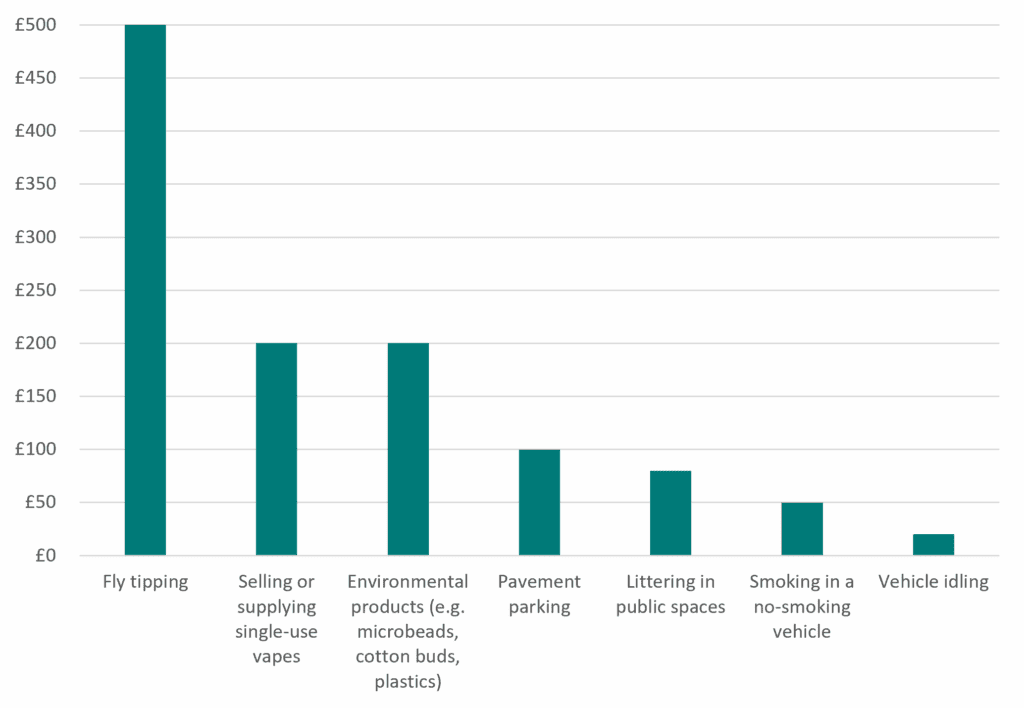
- the penalty level is lower than that for other environmental and traffic offences (see Annex 1)
- the penalty level is not in keeping with wider developments within the UK and the European Union. For example:
- Westminster City Council has set the fine level for engine idling offences at £80 (since 2017) to reflect the increased exposure risks associated with poor air quality hotspots and high levels of pedestrian activity
- From September 2026, engine idling offences in Wales will be subject to fines ranging from £75 to £150 to ‘…reflect the serious consequence of air pollution which idling contributes to’[23].
- Across Europe, penalties for engine idling offences are higher than in Scotland with fines of €49 in Luxembourg[24], €80 in Germany[25], €130 in Belgium[26] and €135 in France[27].
7.6
Having reviewed the evidence, ESS considers that Regulation 8(b) of the 2003 Regulations is ineffective environmental law. Whilst the issuing of FPNs has been viewed as a ‘last resort’, the evidence suggests that, in reality, the low value of the FPN acts as a barrier to enforcement as the costs of administering an FPN can be greater than the value of the penalty itself. In addition, the current level of the fine is disproportionately low compared to other offences and risks failing to provide a credible deterrent.
7.7
Given the above, ESS recommended to the Scottish Government that it should review Regulation 8(b) (which prescribes the current FPN fine level) and give consideration to the level at which the FPN would function as an effective deterrent for stationary idling offences. For the following reasons, the Scottish Government did not accept this recommendation:
- idling penalties in England also remain set at £20
- higher penalties for other offences (such as fly‑tipping) reflect different policy considerations
- any legislative change would require robust evidence and parliamentary resource
- idling activity is declining due to technological advances, including start/stop technology, increased uptake of electric vehicles, and cleaner bus fleets associated with LEZ implementation
- stationary idling contributes only a small proportion of overall air pollution
7.8
The Scottish Government further advised that its current focus is on education and public engagement rather than increasing penalty levels but indicated that the outcomes of the Welsh Government’s reforms will be considered in due course, once sufficient evidence is available, when assessing whether similar changes may be appropriate in Scotland.
7.9
ESS recognises the Scottish Government’s position, including its emphasis on proportionality, evidential requirements and wider policy considerations. However, as set out above, the effectiveness of enforcement depends in part on whether penalties operate as a credible deterrent. In relation to technological advances, while measures such as stop‑start systems, fleet electrification and cleaner vehicles are expected to reduce emissions over time, available evidence suggests that transition is uneven and varies across regions and socio-economic groups[28]. Additionally, between 2003 and 2024, there has been a 20% increase in petrol and diesel vehicles licensed in Scotland[29] (480,000 vehicles), with 90% of cars on the road in 2024 being petrol or diesel engined. On this basis, it is important that the deterrence principle inherent within the 2003 Regulations remains effective.
7.10
ESS considers that an enforcement system that is rarely used on the basis of the cost to administer it is structurally flawed and risks defeating the purpose of the statutory regime. Accordingly, ESS maintains its position that Regulation 8(b) should be reviewed with a view to increasing the level of the value of the FPN so that it no longer amounts to an operational barrier to local authorities, and acts as a credible and thus effective deterrent to drivers committing stationary idling offences.
[21] The effectiveness of enforcement measures – Litter and flytipping offences – enforcement review: final report – gov.scot
[22] Citizen Participation and Public Petitions Committee – PE1944 – Note by the Clerk
[23] Tackling stationary engine idling | GOV.WALES
[24] Grand-Ducal Regulation of 22 April 2009 amending the … – Legilux
[25] Keeping the engine running – Nature & Environmental Protection 2026
[26] Wallonia to fine drivers who keep car engine running | The Bulletin
[27] France Traffic Fines – Cosmos Legal
[28] Psychological interventions for environmental impact: A field experiment on reducing engine idling – ScienceDirect
[29] Transport Scotland – Transport statistics 2025 (road transport vehicles)